
When Life Gives You Tangerines is 16 episodes on Netflix, and the English subtitles only carry about half the story. The Korean title is Jeju dialect for “thank you for your hard work,” and that one line explains the whole show. The story follows Oh Ae-sun and Yang Gwan-sik, two people born on Jeju Island in the 1950s, across fifty years of marriage, children, poverty, and small victories. It is a romance and slice-of-life drama, told by their daughter as an older woman looking back.
This guide explains what the subtitles miss. The show is built from things subtitles cannot carry: a dialect that most Korean viewers also find hard, a title that means something different from its English name, and a whole culture of women divers that most viewers outside Korea have never heard of. You do not need to know Korean to enjoy the show. But knowing these three things changes how you watch it.
Contents
- What is When Life Gives You Tangerines about?
- Who are the main characters?
- Does it have a twist?
- Which episodes matter most?
- What do the subtitles miss?
- The real Jeju behind the story
- How did Korea react?
- Where else have you seen the cast and creators?
- Frequently asked questions
- Your 3 next steps
What is When Life Gives You Tangerines about?
The short version: a poor Jeju girl who wants to become a poet, and the quiet boy who loves her his whole life. Ae-sun is born in 1951 into a poor family in Dodong-ri, a village on Jeju Island. Her mother is a haenyeo, one of the women divers who harvest seafood without oxygen tanks. Ae-sun is bright, stubborn, and full of words. She wants to write poems. Poverty and the times keep getting in her way. Gwan-sik is the boy next door. He does not talk much. He stays by her side for fifty years.
The story runs from the 1950s to the 2000s. It moves between Jeju, Seoul, and Busan. The couple marries young, raises three children, moves to the city, and grows old. The structure is unusual: the series is told out of order, and their daughter Geum-myeong narrates as an older woman. Scenes come back later with new meaning. A moment that looks small in episode 2 can break your heart in episode 14, once you know what it cost.
Netflix released all 16 episodes as four volumes of four, on Fridays March 7, 14, 21, and 28, 2025. Each volume is named for a season: Spring, Summer, Autumn, Winter. The show is a complete limited series. There is no second season, and nothing is left hanging. Episode lengths run from 49 to 85 minutes, so plan for long evenings. The age rating is 13+.
The English title is a translation of a feeling, not of the words. The Korean title is 폭싹 속았수다, Pokssak sogatsuda. In Jeju dialect it means “thank you for your hard work.” That is the whole show in one sentence: gratitude for ordinary lives, said in the dialect of the island where it happens.
When Life Gives You Tangerines: 7 Things Subtitles Miss covers the same show from a different angle, with seven subtitle details and a spoiler-free episode guide. Read that one too if you want the full picture.
Who are the main characters?
Five people carry the story: Ae-sun, Gwan-sik, and their three children. The casting is unusual. Every lead is played by several actors, one for each stage of life. IU plays Ae-sun as a young woman and also plays her daughter Geum-myeong. Moon So-ri plays the older Ae-sun. Park Bo-gum plays the young Gwan-sik, and Park Hae-joon plays the older Gwan-sik. The effect is that you watch one life pass through several faces, and it works.
| Character | Actor | Who they are |
|---|---|---|
| Oh Ae-sun | IU (young), Moon So-ri (older) | A spirited Jeju girl born in 1951 who dreams of becoming a poet. She says what she thinks, even when it costs her. |
| Yang Gwan-sik | Park Bo-gum (young), Park Hae-joon (older) | A quiet, steady young man who loves Ae-sun since childhood and protects her his whole life. |
| Yang Geum-myeong | IU | The couple’s daughter and the narrator. She tells her parents’ story as an older woman looking back. |
| Jeon Gwang-rye | Yeom Hye-ran | Ae-sun’s mother, a haenyeo diver. She feeds the family from the sea and pushes her daughter to study. |
| Yang Eun-myeong | Kang You-seok | The couple’s older son. He grows up between Jeju and Seoul. |
| Park Chung-seop | Kim Seon-ho | The man Geum-myeong marries. Her first love, Park Yeong-bum (Lee Jun-young), comes before him. |
| Yeom Byeong-cheol | Oh Jung-se | Ae-sun’s stepfather. He enters the family after her mother’s death. |
Three supporting figures matter more than they first appear. Gwang-rye’s fellow haenyeo friends, played by Cha Mi-kyung, Lee Soo-mi, and Baek Ji-won, are the community that raises Ae-sun. Gwan-sik’s mother Kwon Gye-ok, played by Oh Min-ae, is the mother-in-law Ae-sun has to live with as a young bride. And Bu Sang-gil, played by Choi Dae-hoon, is the wealthy fishing captain who was once set to marry Ae-sun. He is the life she did not choose, and he keeps reappearing.
One detail worth knowing before you start: the three children are named after medals. Geum-myeong carries the word for gold, Eun-myeong for silver, and Dong-myeong for bronze. Gwan-sik names them that way because he wants them to win at life. The names are a father’s wish, and the show keeps returning to what that wish costs.
Best K-Dramas on Netflix for First-Time Viewers lists four finished dramas to start with, including the biggest romance hits. If Tangerines is your first K-drama, that list is a good next stop.
Does it have a twist?
Not in the way most dramas mean it. There is no hidden identity, no secret villain, no last-minute reveal that changes everything. The show tells you early that it is a life story, and it stays a life story. Critics compared it to reading chapters of a book: each episode works on its own, and the meaning builds slowly.
What feels like a twist is time itself. The story is told out of order, and the narrator is the daughter looking back. A scene you watched in episode 2 comes back in a later episode with new context, and suddenly you understand what the characters were really saying. The show trusts you to remember. It does not explain itself twice.
So if you are waiting for a shock, you will wait in vain. If you like slow family sagas where the payoff is emotional rather than surprising, this is the show. The ending is both happy and sad, and that is all this guide will say about it. The last episode is titled “Here’s to All You’ve Been Through,” which is also the last line of the poem Ae-sun writes for Gwan-sik. That is the title of the whole story, in the end.
D.P. Netflix: 7 Korean Military Truths Subtitles Miss is our other spoiler-free guide in this series, about a military drama where rank changes the way soldiers speak.
Which episodes matter most?
All 16 episodes matter, because the story is one life told in four seasons. But if you want to know whether the show is for you, watch the first volume and decide. Spring sets the whole story: Ae-sun’s girlhood, her mother’s work as a diver, and the first moves of her romance with Gwan-sik. If the pace feels slow, that is the show. It stays slow, and the slowness is the point.
| Volume | Episodes | What happens (setup only, no ending spoilers) |
|---|---|---|
| Spring | 1 to 4 | Ae-sun’s girlhood in Jeju, her young romance with Gwan-sik, and the tragedy that changes her family. Released March 7, 2025. |
| Summer | 5 to 8 | The couple raises a family on little money. Gwan-sik looks for work, Ae-sun aims higher, and a storm tests them. Released March 14, 2025. |
| Autumn | 9 to 12 | Geum-myeong’s Seoul years: work, romance, and the choice between her first love and her own plans. Released March 21, 2025. |
| Winter | 13 to 16 | The family’s later years, career changes, and the rewards of a lifetime of work. Released March 28, 2025. |
Two episodes are good test points. Episode 1, “Spring in a Heartbeat,” shows you the tone: bright, funny, and sad in the same scene. Episode 9, the start of Autumn, shows you the second generation: Geum-myeong in Seoul, which is a different show inside the same show. If you finish episode 4 and want to know what happens to these people, keep going. The show rewards patience more than any other K-drama on Netflix right now.
5 Best Korean Movies to Stream in the US Right Now (2026) is the film version of this kind of guide, with a key episode or key scene for each title.
What do the subtitles miss?
The subtitles translate the words. They cannot translate how the words are said. Three things get lost, and all three are the point of the show.
First, the Jeju dialect. The characters speak Jeju language, not standard Seoul Korean. Jeju dialect is so different that most Korean viewers also find it hard. The show uses it on purpose: it marks who belongs to the island and who does not. The title itself is Jeju dialect. When a character says “폭싹 속았수다,” the subtitle reads “thank you for your hard work.” That is correct, and it is also thin. In Jeju, the phrase carries the weight of a whole life of labor. It is what you say to someone who has carried a family on their back for fifty years. The English title, “When Life Gives You Tangerines,” tries to carry the same feeling with a different image: sour fruit turned into something warm to drink. IU herself explained it that way.
Second, speech levels. Korean changes its words based on who is talking to whom. A polite sentence can be a threat. A casual word can be an insult. In this show, the difference matters most inside the family. Ae-sun speaks bluntly, even to her elders, and that bluntness is her character. Gwan-sik barely speaks at all, and his silence is his character. When Ae-sun switches from blunt speech to formal speech, the subtitle shows the same English words. The Korean viewer hears a whole change of heart. The show also uses the old Jeju way of addressing people, which sounds rough to Seoul ears and warm to Jeju ears. The subtitles flatten all of that into plain English.
Third, jeong and han. Jeong is the deep affection that builds over a long shared life. Han is the sorrow that stays in the chest when life is unfair and cannot be fixed. English has no single word for either. The show is built from both. Ae-sun and Gwan-sik stay together not because life is easy but because jeong holds them. The hardships they cannot fix, the poverty, the losses, the things the times did to them, sit in the story as han. When a character cries without explaining why, the subtitle gives you the words. The feeling behind the words is jeong and han, and you have to watch the faces to get it.
One small sound to listen for: the sumbisori. When a haenyeo surfaces from a dive, she lets out a short whistling breath. It is called sumbisori, and it is the sound of a diver coming back alive. You will hear it in the sea scenes. The subtitles never mention it. It is one of the most Jeju sounds in the world.
Netflix vs Viki vs Kocowa: Where to Watch K-Dramas in the US compares the three services on price, subtitles, and catalog, so you can check where any title streams before you subscribe.

The real Jeju behind the story
Jeju is not just a pretty background. The island shapes every part of the story. Jeju is the largest island of South Korea, about 85 kilometers off the southern tip of the peninsula. It is volcanic rock, wind, and sea. The old Jeju saying lists three things the island has in abundance: wind, stone, and women. The wind bends the trees. The stone builds the walls. And the women, the haenyeo, fed the island.
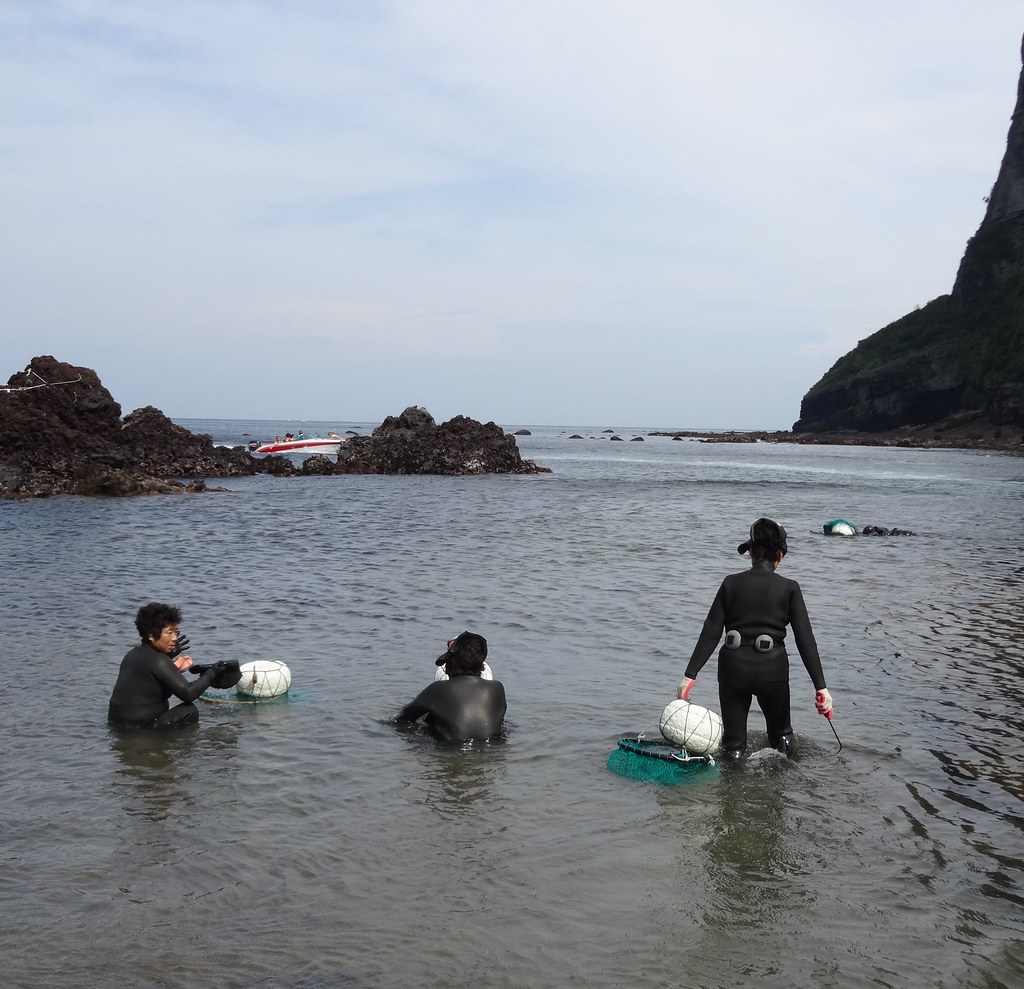
Haenyeo means “sea women.” They dive for abalone, sea urchin, and shellfish without oxygen tanks, holding their breath for about two minutes and diving 5 to 20 meters deep. The tradition goes back hundreds of years. UNESCO inscribed the Culture of Jeju Haenyeo on its Representative List of the Intangible Cultural Heritage of Humanity on November 30, 2016. What UNESCO recognized was not only the diving skill but the whole way of life: the cooperatives, the knowledge of the sea passed between generations, and the role of women as the center of the household economy.
That world is fading. There were about 23,000 haenyeo in 1965. By the end of 2024 there were about 2,600 active divers, and the average haenyeo today is around 70 years old. The show is set in the decades when that world was still whole. Ae-sun’s mother, Gwang-rye, is a haenyeo. Her friends are haenyeo. The sea is not a hobby for them. It is how the family eats. When you watch the diving scenes, remember that the women on screen are playing the last generation of a real tradition.
The era matters too. Ae-sun is born in 1951, just after the Korean War. Jeju in the 1950s and 1960s was poor. Children left school to work. Families moved to Seoul for jobs. The show follows that migration: the couple leaves the island, lives in a cramped Seoul apartment, and sends their children to schools they never had. The poverty is not decoration. It is why Ae-sun cannot become a poet when she is young, and why it matters so much when she finally does. The show also touches the old Jeju world that Seoul does not see: the stone walls, the village chief elections, the shaman grandmother, and the way neighbors raise each other’s children.
Teach You a Lesson: Korean School System Behind the Drama is our other guide that explains the real Korea behind a show, this time the school system and the teacher crisis of 2026.
How did Korea react?
Korea did not just watch this show. It lived with it for months. Gallup Korea ranked When Life Gives You Tangerines the favorite TV program in March, April, and May 2025, three months in a row. It was the first drama to score above 10% preference since January 2013. Good Data Corporation ranked it first for TV and streaming drama topicality for seven weeks in a row.
The global numbers matched. The series reached No. 1 on Netflix’s global non-English TV chart in the week of March 17 to 23, 2025, with 65.5 million viewing hours, and it stayed on the chart for nine weeks. In its first month it logged 60 million views. It holds an IMDb score of 9.2, the highest for a Korean drama on Netflix, and Rotten Tomatoes shows a 98% audience score. Time named it the best Korean drama of 2025.
The awards followed. At the 61st Baeksang Arts Awards, the show won four of its eight nominations, including Best Drama and Best Screenplay for writer Lim Sang-choon. It also took the Grand Prize at the Blue Dragon Series Awards. The cast won too: IU, Park Bo-gum, and Moon So-ri each took top acting honors at the Asia Artist Awards.
The reaction went beyond ratings. After the release, airlines reported that seats to Jeju for the first week of May had sold out. The show’s retro styling reached the shops: so-called grandmacore fashion and mother-of-pearl chests trended after the release. In November 2026, more than a year and a half after the finale, the show climbed back to No. 6 on the KOFICE Hallyu weekly chart. People were still talking about it. That is rare for a finished limited series. If this is your first K-drama, Best K-Dramas on Netflix for First-Time Viewers explains why shows like this one stay with viewers long after the finale.
One Korean reaction is worth knowing before you watch: older Korean viewers saw their own parents in Ae-sun and Gwan-sik. The director, Kim Won-seok, said he made the show as a salute to his parents’ and grandparents’ generations. In Korea, the show became a reason for adult children to call their parents. That is not a marketing line. It is what the Gallup numbers and the sold-out flights to Jeju were measuring.
Where else have you seen the cast and creators?
The writer is Lim Sang-choon. Before this show, she wrote When the Camellia Blooms (2019), one of the most loved Korean dramas of recent years, and Fight for My Way (2017). Her work is known for warm, funny, ordinary people who keep going. If you liked the tone of Tangerines, Camellia Blooms is the closest next watch.
The director is Kim Won-seok. He directed My Mister (2018), also with IU, which is one of the most praised Korean dramas ever made. He also directed Signal (2016) and Misaeng (2014). My Mister is slower and sadder than Tangerines, but it has the same patience with ordinary lives. This is his second project with IU.
IU is one of Korea’s biggest stars, as a singer and an actor. Before Tangerines, she led Hotel del Luna (2019) and My Mister (2018), and she starred in the film Broker (2022). Park Bo-gum became a star with Reply 1988 (2015), one of the most beloved Korean dramas of all time, and Love in the Moonlight (2016). He also led Record of Youth (2020). Moon So-ri is a film legend in Korea: Oasis (2002), A Good Lawyer’s Wife (2003), and Three Sisters (2020). Park Hae-joon is known for The World of the Married (2020) and My Liberation Notes (2022).
Two younger names to remember. Kim Seon-ho, who plays Park Chung-seop, became a star in Hometown Cha-Cha-Cha (2021) and Start-Up (2020). Lee Jun-young, who plays Geum-myeong’s first love Park Yeong-bum, is a singer turned actor with a growing list of drama roles. Both are worth following after this show.
5 doramas cortos para el fin de semana en Netflix is our Spanish-language list of five short K-dramas you can finish in one weekend, all on Netflix US with Spanish subtitles.
Frequently asked questions
Is When Life Gives You Tangerines still on Netflix in the US?
Yes. As of November 15, 2026, the full series streams on Netflix in the United States, according to JustWatch. It is a Netflix Original, so it does not rotate to other US services the way licensed shows do. All 16 episodes are available. Check the Netflix app before you start, because catalogs change.
How many episodes are there, and how long is each one?
There are 16 episodes, released as four volumes of four in March 2025. Episode lengths run from 49 to 85 minutes. The whole series is about 17 hours. There is no season 2. The story is complete.
Do I need to know Korean to enjoy it?
No. The story works with English subtitles. But you will enjoy it more if you know what the subtitles miss: the Jeju dialect, the speech levels, and the meaning of the title. That is what this guide is for. When Life Gives You Tangerines: 7 Things Subtitles Miss covers seven more subtitle details.
Is it based on a true story?
No. Ae-sun and Gwan-sik are fictional. But the world is real: the haenyeo divers, the Jeju villages, the poverty of the 1950s and 1960s, and the migration to Seoul all come from real Korean history. The writer and director built the fiction out of that real world.
Is it sad?
It is both sad and warm. People cry watching it, and people laugh watching it, sometimes in the same scene. The ending is both happy and sad. If you like slow family sagas like Reply 1988, you will like this. If you want fast plot twists, this is not the show. 4 K-dramas románticos en Netflix para empezar en 2026 is our Spanish-language romance starter list, with four finished dramas to try next.
Your 3 next steps
- Watch episode 1, “Spring in a Heartbeat,” tonight. If the pace feels slow, give it one more episode. The show rewards patience.
- Listen for the Jeju dialect and the sumbisori in the sea scenes. The subtitles will not flag them, but now you know what to hear.
- When you finish, read the Good Data and Gallup numbers in this guide again. You will understand why Korea spent three months talking about this family.
Availability changes often, so confirm the title in your Netflix app before you settle in. Netflix


