
D.P. on Netflix is a Korean military drama about a unit that tracks down deserters. It runs 12 episodes across two seasons, and this guide is spoiler-free. The subtitles translate the words, but they cannot show how rank changes the way soldiers speak. This guide explains the characters, the key episodes, and the real Korean military life behind the show.
Here are the facts first. Season 1 premiered on Netflix on August 27, 2021, with 6 episodes. Season 2 followed on July 28, 2023, also with 6 episodes. The director is Han Jun-hee. The writers are Kim Bo-tong and Han Jun-hee. The show is based on the webtoon “D.P 개의 날” by Kim Bo-tong, published on Lezhin Comics in 2015. The New York Times named it one of the best shows of 2021. Its IMDb score is 8.2. In the United States, you can watch it on Netflix and on Netflix Standard with Ads (checked November 9, 2026). English subtitles are available on Netflix US. Check the subtitle menu in the Netflix app before you start.
What is D.P. about?
D.P. stands for Deserter Pursuit. It is a real unit in the South Korean military police. Its job is to find soldiers who leave their posts and bring them back. The story follows Private An Jun-ho, played by Jung Hae-in. His sharp eye gets him assigned to the D.P. unit. His partner is Corporal Han Ho-yeol, played by Koo Kyo-hwan. Ho-yeol knows the streets, the tricks, and the shortcuts of the job.
Each episode follows one case, one deserter with a story behind the desertion. But the show is not a chase drama. Each case asks why the soldier ran. The answers point to hazing by a superior, debt, a broken family, or an unfair punishment. The tone is serious and direct. There is no romance and little comic relief. The show depicts graphic violence, verbal abuse, and suicide. Netflix rates it TV-MA. Know that before the first episode.
The story is set in 2014. That detail matters. It is the Korea of flip phones and old subway maps, not the Korea of today. The time setting keeps the focus on the barracks, not on modern phones and social media.
Good next read: What Netflix Subtitles Miss in The Glory – If you liked how D.P. handles Korean hierarchy, The Glory does the same with school violence and speech levels. That guide explains what its subtitles miss too.
Who are the main characters?
| Character | Actor | How they speak | Their role |
|---|---|---|---|
| An Jun-ho | Jung Hae-in | Formal, brief, almost no raised voice | The lead. A new soldier in the D.P. unit. He watches more than he talks. |
| Han Ho-yeol | Koo Kyo-hwan | Casual with equals, respectful with superiors | A corporal and Jun-ho’s partner. He teaches the street work. |
| Park Beom-gu | Kim Sung-kyun | Short, direct orders of a sergeant | The sergeant in charge of the D.P. unit. He protects his team as best he can. |
| Im Ji-seop | Son Seok-koo | Cold, formal speech of an officer | A lieutenant. He stands for the chain of command and its limits. |
Jung Hae-in plays An Jun-ho. Before D.P., he was known for romance dramas: Something in the Rain (2018) and One Spring Night (2019). After D.P., he starred in Snowdrop (2021) and Love Next Door (2024). In D.P. he changes register completely. He barely smiles and says very little. That silence is the performance.
Koo Kyo-hwan plays Han Ho-yeol. Before the show, he was known in film for Peninsula (2020) and Escape from Mogadishu (2021). Kim Sung-kyun, who plays Park Beom-gu, is known for Reply 1988 (2015) and the film series The Outlaws. Son Seok-koo, the lieutenant Im Ji-seop, is known for My Liberation Notes (2022) and the film The Roundup (2022). The director Han Jun-hee directed the film Coin Locker Girl (2015) before D.P.
Are there plot twists?
Yes, and without revealing anything: the cases are never what they look like at the start. Each episode opens with a deserter and ends with a different story than expected. What looks like a run from cowardice turns out to be a run from something that happened inside the barracks.
The biggest turn is not a script trick. It is the change in An Jun-ho. At first he only follows orders. With each case, he starts to ask whether bringing the deserter back is the right thing. That doubt grows across both seasons. It is the tension that holds all 12 episodes together.
Season 2 changes scale. It is no longer only about single cases. The show moves into corruption inside the military and an investigation into the death of a soldier. Without spoilers, the question changes from “why did this soldier run” to “what is the institution hiding.” The story ends in episode 6 of season 2. No third season has been announced.
Which episodes matter most?
Without spoilers, these are the episodes not to skip. Season 1 episode 1, “A Man Holding Flowers,” introduces the D.P. unit and the first case. It sets the tone for the whole show. Season 1 episode 4, “The Monty Hall Problem,” shows how relentless hazing changes a kind soldier. Season 1 episode 6, “Onlookers,” closes the first season with the hardest case. It explains why Jun-ho no longer sees his job the same way.
Season 2 episode 1 opens a bigger story, with the unit under pressure. Season 2 episode 6 is the finale. It closes both the main case and Jun-ho’s change. If time is short, do not skip episodes. Each case leaves a piece that only makes sense at the end. Episodes run about 45 to 55 minutes each.
What do the subtitles miss?
The subtitles translate words, not hierarchy. In the Korean military, the way you speak already says who commands and who obeys. That hierarchy is the heart of the story. Here are the three things English subtitles cannot carry.
First, formal speech and casual speech. Korean has jondaenmal, formal speech, and banmal, casual speech. A junior soldier must use formal speech to a senior. He cannot switch to casual speech, even off duty, even when the senior is wrong. The subtitles show both as plain English. You lose the moment when a soldier breaks the rule and speaks casually to a senior. That break is an act of defiance. In English it looks like a normal line.
Second, the salute word “Chungseong.” It means loyalty. Soldiers shout it when they salute and when they answer an order. The subtitles usually render it as “Yes, sir” or drop it. The shout is not only an answer. It is a performance of obedience. When a soldier says it weakly, or late, or not at all, other soldiers notice. That small difference carries meaning the subtitles flatten.
Third, the senior and junior words seonbae and hubae. A seonbae is a senior, a hubae is a junior. In the barracks, the gap between them decides who eats first, who sleeps where, and who can speak. The subtitles often translate these as names or drop them. The rank words disappear, and with them the reason a scene feels tense. Watch for who bows lower, who speaks first, and who stays silent. That body language is the subtitle the show gives you for free.
How did Korea react?
The show started a public fight about hazing in the military. When season 1 came out in August 2021, it did not just become a hit in South Korea. It sparked real conversations about mandatory service, systemic abuse, and the cost of staying silent. Korean viewers debated it in online communities, and the press covered the debate. The reason was simple: many Korean men recognized the barracks on screen.
The creator Kim Bo-tong served in a real D.P. unit during his own military service. He wrote the webtoon from that experience. The cases in the drama track closely to real cases in the military. That is why the show hit so hard in Korea. It was not a foreign story about a strange army. It was a story about a shared experience that most Korean men live through and few talk about in public.
Season 2 kept the debate going. It moved from single cases to corruption and the investigation into a soldier’s death. Korean coverage treated that shift as the point of the show: the problem is not one bad senior, it is a system that protects itself.
Is the D.P. unit real?
Yes. Deserter Pursuit is a real unit in the South Korean military police. Its job is what the show says: find soldiers who leave their posts and bring them back. The unit is small, and its members work in plain clothes in the streets. That is why the show looks like a detective story. The pair walks through markets and subway stations, not only through barracks.
The background is conscription. Under the Military Service Act, all able-bodied South Korean men must serve. Army service lasts 18 months as of 2026. Most men enlist between 18 and 28. The Korean War ended with an armistice in 1953, not a peace treaty. The two Koreas are still technically at war. That is the root of conscription, and it is why the military touches nearly every Korean family.
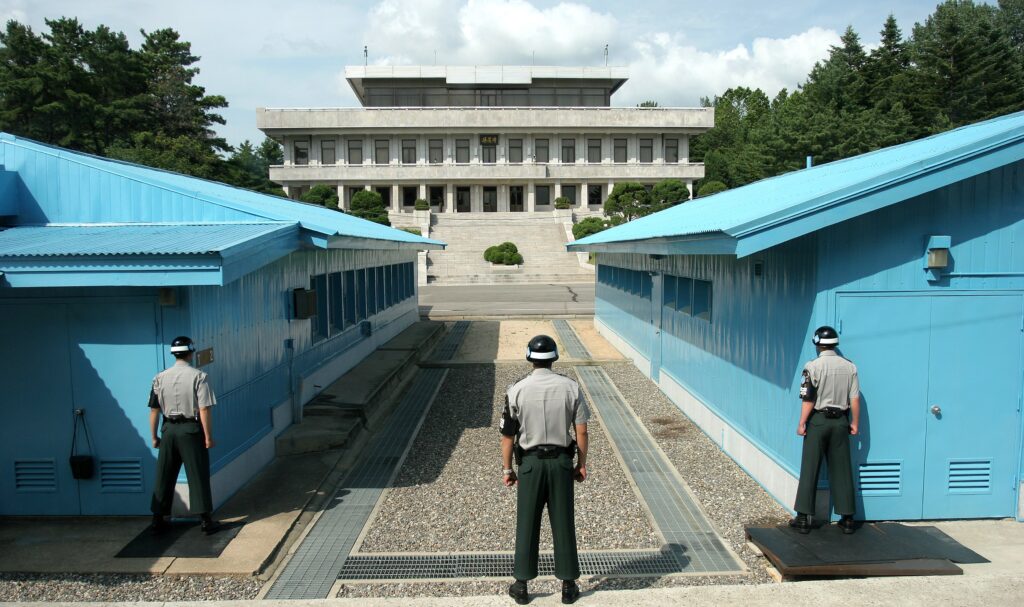
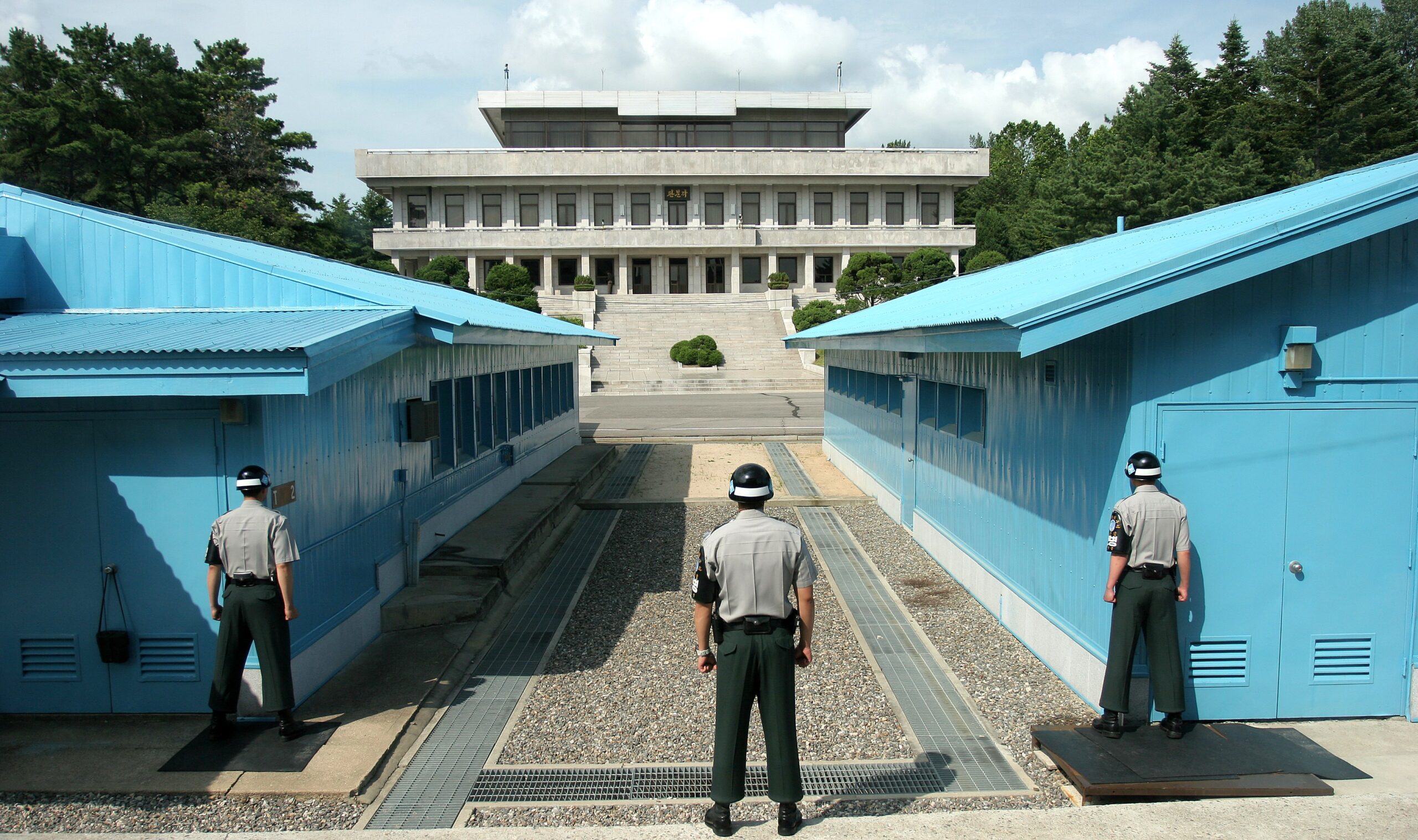
The DMZ is the physical form of that unfinished war. It is a buffer zone about 4 kilometers wide that has divided the peninsula since the 1953 armistice. The photo above shows Panmunjeom, the Joint Security Area inside the DMZ, where South Korean soldiers stand guard between the blue meeting buildings. D.P. never goes to the DMZ, but the DMZ is the reason the army, and the D.P. unit, exist.
Where can you watch D.P. in the US?
Both seasons stream on Netflix in the United States, on the standard plan and on Netflix Standard with Ads. Availability was last checked on November 9, 2026. Catalogs change, so check Netflix before you start. English subtitles are available. If you are learning Korean, try Korean audio with English subtitles first, then rewatch a scene with Korean subtitles to catch the speech levels.
The show is complete at 12 episodes. Start with season 1 episode 1. The episodes are short for a K-drama, about 45 to 55 minutes each, so two evenings cover a season. The content is heavy. If you watch with family, note the TV-MA rating and the scenes of violence and abuse.
What else have the director and cast made?
Director Han Jun-hee made the film Coin Locker Girl (2015) before D.P. That film also deals with crime and loyalty, and it shows the same film-quality look. Writer Kim Bo-tong wrote the original webtoon in 2015 and co-wrote the show.
For the cast, start with these. Jung Hae-in: Something in the Rain (2018) and One Spring Night (2019) show his romance side, the opposite of Jun-ho. Koo Kyo-hwan: Escape from Mogadishu (2021) is a tense film about diplomats escaping a war zone. Kim Sung-kyun: Reply 1988 (2015) is a warm family drama and a good reset after D.P. Son Seok-koo: My Liberation Notes (2022) is a quiet drama about three siblings, and it shows the same restrained acting he brings to Im Ji-seop. If you want more on how Korean shows handle speech levels, our Spanish-language D.P. guide covers the same ground for Spanish-speaking viewers: D.P.: la cultura militar que los subtítulos no muestran.
Frequently asked questions
Is D.P. based on a true story?
It is based on real experience, not one real case. Creator Kim Bo-tong served in a real D.P. unit and wrote the webtoon from that service. The cases track closely to real military cases. For more on how Korean shows handle real social issues, see What Netflix Subtitles Miss in The Glory.
Is D.P. violent?
Yes. The show depicts graphic physical violence, verbal abuse, and suicide. It is rated TV-MA. The violence is not action-movie fun. It is the point of the story: it shows what hazing does to people.
Do I need to know Korean to enjoy D.P.?
No. The story works with English subtitles. But you will miss the speech-level tension explained above. Watch for who bows, who speaks first, and who stays silent. That body language carries what the subtitles drop.
Will there be a D.P. season 3?
No third season has been announced. The story closes in season 2 episode 6. Treat the 12 episodes as complete.
Where can I find more Korean shows like this?
Start with The Glory for the same theme of hierarchy and revenge. Our guide to it is here: What Netflix Subtitles Miss in The Glory. If you want a lighter next step after D.P., our guide to buying Korean cosmetics in the US is a practical change of pace: Cosméticos coreanos en EE. UU. 2026.
3 things to do today
- Open Netflix and check that D.P. shows English subtitles in the subtitle menu before episode 1.
- Watch season 1 episode 1 and note one moment when a junior soldier switches speech level.
- Read the “How did Korea react?” section again after episode 4, when the hazing story lands.
Keep reading
Sources: Wikipedia (English and Spanish) and DramaWiki for dates, cast, and crew; Unniepop review (September 1, 2021) for Kim Bo-tong’s service; kdramareviews.net and Rotten Tomatoes for reception; Reelgood (updated November 9, 2026) and JustWatch US (checked November 7, 2026) for streaming availability; Military Service Act and legalclarity.org for service length and the 1953 armistice. Streaming availability changes, so check Netflix before you start.


